Divine Harmony
By
Maulana Shah
Muhammad Abdul Aleem Siddique
(1892-1954)
In my old age, I have undertaken the present world tour, with all its attendant hardships, only with the mission of delivering the message of peace and goodwill to my fellow beings so that they might be able to avoid conflicts and quarrels and to live in harmony.
After years of serious thinking, I have come to the conclusion that the real cause of human strife and wars consists in selfishness, on the one hand and the forgetfulness of God on the other. When people begin to act in utter self-interest, when the social obligations are forgotten, when one can stoop down so low as to pursue one's interests at the cost of the rights of the other, harmony and concord recede in the background. Similarly, when men become so engrossed in earthrootedness that they do not find the occasion to remember their Creator even formally, when the relations between the supreme source of power are cut off, when we cease to feel that by breaking the divinely appointed laws of nature, we are only destroying the harmony of human existence, peace must become a thing unattainable.
We all experience it in our daily lives that whenever we break the physiological laws of nature, we feel ill and have to endure bodily pain. Similarly is the case of the divinely-ordained moral laws. By breaking them, we invite nothing else than misery. If one breaks the heart of someone today, one must be ready to suffer a similar pain tomorrow.
Everyday and every night you hear music and songs in the recreational programmes over the radio. Did you ever consider from where this melody, which captivates your hearts and enchants your ears, did acquire that sweetness? If you have seen an orchestra, you must have noticed that it always contains several musical instruments, each one possessing its own sounds and tunes. Now, if all the instruments are played at one and the same time, and the players make it a point to play independently, you will hear nothing but discordant and jarring sounds. It is only when those in charge of the orchestration bring the different tune of the different instruments into harmony with one another, that you get that symphony which enthralls and thrills not only the listeners but the players themselves.
Thus, I would like you to consider every human figure like the musical instrument participating in musical performance. Learn the lesson of harmony from the orchestra. Remember that the moment you succeed in creating the requisite harmony with your fellow being, melodious tune will emanate from human life, imparting that sweetness which unfortunately, has now become a thing of the past.
Beautiful faces and beautiful things come before you, day and night enchanting your hearts. You say that you consider the face of so and so as beautiful, and you declare your love for that beauty. At this occasion I would not drag you into a discussion on the nature of love. I might tell you later on, that what people call love today is not love in the real sense or the term, but only a name for vulgar appetites, rooted in the lower form of desire. Actually love denotes that holy state of mind which has no reference to self-interest and baser passions.
However even if you think that love is nothing but an inclination which is sensuous in nature, I would like you to consider the problem: from where came this beauty and grace which attract your hearts? From where came those superior distinctions which make you bow down? Could these material bodies become so beautiful and seemingly so perfect by themselves, or, is there some Supreme power who creates the beauty and imparts distinctions? If you doubt the existence of that Supreme Being, we might discuss it at some other occasion. But if your nature itself and your inner voice tells you that there is someone who is the maker of this universe, then rest assured that all this beauty and perfection which you see in this world is only a manifestation of that really Beautiful and Perfect Being whom all sensible people of all religions call God. One step further you shall be able to feel that, if the beauty and perfection of created things are so attractive, how beautiful and perfect should He be who is the Creator.
You allow yourselves to be absorbed in the beauty of created things. But I would like you to focus your attention on Him, the really beautiful and the really perfect being, in Whom is the origin of all life. Think of Him and love Him. Your attitude of love will help in increasing your consciousness of God's omnipresence. Until you will find it impossible to act against His law. Then you will hurt none, you will break the heart of none, you will cheat none, and you will insult none. On the other hand you will feel the blacks and the whites, the poor and the rich, the lowly and the high-placed are all God's family and consequently your own brothers and sisters. Your love for God will compel you inwardly to love your fellow beings. When this attitude of mind has been attained, the world will have peace in the true sense of the word.
You are accustomed to hear the melodies of human song from the radio. Today you have heard about the melody of Divine Harmony. Let us henceforth think of God and Love Him with ever-increasing devotion, let us adopt the higher forms of human morals, and let us endeavour to build up a true Humanity.
His Exalted Eminence
Maulana Muhammad Abdul Aleem Siqqidi Al-Qadri R.A (1892-1954)
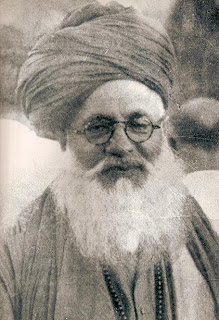
Born in the blessed month of Ramadhan, on 3 April 1892 (15 Ramadhan 1310), in Meerut India, Maulana Shah Muhammad Abdul Aleem Siddique was raised in a family that was pious and devout. He is a descendant of Sayyidina Abu Bakar As-Siddique (may Allah be pleased with him), the first caliph of Islam.
From a small age, his father, Muhammad Abdul Hakim and his mother were his inspiration and source of guidance and education in the teachings of Islam.
He was an exceptionally intelligent child and possessed an intellectual capacity beyond his years. He brilliantly committed the Holy Qur’an to his memory when he was only 4 years old. He also had a remarkable oratory skill and at the age of 9, he delivered his first public speech at the Jamma Mosque of Meerut, mesmerising the audience with his captivating eloquence.
He had a remarkable love and thirst for knowledge. At the age of 16, he graduated with a Degree and distinctions in Islamic Theology. He then pursued non-theological studies in modern sciences and Law. He also acquired advanced knowledge in Qur’anic science, Hadith, Tassawuf and Islamic jurisprudence of the four main madhhab. His teachers include Shaykh Ahmad al-Shams of Morocco, Shaykh Al-Sennousi of Libya, Maulana Abdul Bari of Farangi Mahal and Maulana Ahmad Mukhtar Siddique (his brother). He achieved great Islamic theological and spiritual development under the guidance of Maulana Ahmad Raza Khan, a revered Islamic scholar and a great Sufi master.
Maulana Abdul Aleem Siddique travelled continuously for 40 years to all parts of the globe until his labors of love for the spiritual reform and enlightenment of humanity covered a major part of the world. The countries he visited include the Hejaz, Singapore, Malaysia, Indonesia, Thailand, Burma, Vietnam, Ceylon, China, Japan, Philippines, Mauritius, Madagascar, South Africa, Kenya, Tanzania, Belgium, Egypt, Syria, Palestine, Jordan, Iraq, France, England, West Indies, Guyana, Trinidad & Tobago, Suriname, United States of America and Canada.
He was a great writer, poet, orator and scholar of Islam and modern sciences, and was renowned the world over for his spiritual guidance and promulgation of the message of hope and peace. His contribution to literary and academic discourses was also astounding. In 1935, in Mombassa (Kenya), Maulana Abdul Aleem Siddique met with the famous European intellectual, Sir George Bernard Shaw, and they enjoyed a wonderful exchange of thoughts in which Sir George Bernard Shaw called Maulana Abdul Aleem Siddique “a learned sage”. He delivered hundreds of lectures and also found time to write several Islamic books and poetry in Urdu and English.
He came to Singapore in 1930 to spread the message and beauty of Islam. He laboured intensively in the cause of Islam and delivered numerous lectures in Singapore and attracted many people to Islam. He pioneered the establishment of the All Malaya Muslim Missionary Society, now known as Jamiyah, in 1932. He also pioneered the establishment of the Inter-Religious Organisation (IRO) to foster greater understanding between the faiths and to promote the spirit and message of peace amongst the people of Singapore.
In IRO’s inauguration ceremony, on 18 March 1949 at Victoria Memorial Hall, Maulana Abdul Aleem Siddique gave an inspiring speech, in which he said,
“As far as the common evils and accepted moral principles were concerned, no religion could have any difference, and in the spirit of tolerance and sympathy and the desire to establish peace, all of them were as one. The task of the religious leaders was to let the followers of each and every religion know the teachings of other religions, so that a spirit of fellowship could work together to spread the accepted moral principles and to fight the common evils.”
Maulana Abdul Aleem Siddique worked with single-minded devotion for the cause of Islam and humanity. Hundreds of thousands of people belonging to diverse races and nationalities in Asia, Africa, Europe and America received spiritual blessings through his dynamic and refulgent personality. Numerous mosques, Islamic missionary societies, schools, hospitals, libraries, infirmaries, orphanages and Islamic periodicals sprang up in the wake of his immortal missionary work.
Maulana Abdul Aleem Siddique was an extraordinary exponent who personify in a distinguished manner the causes he cherish and uphold, and his labours for the cause form a landmark in human history. His noble soul soared beyond the limitations of territory and race. The most distinctive aspect of his personality was the spiritual magnetism that he radiated which captivated the minds and hearts of all who crossed his path.
On 22 August 1954 (22 Dhulhijjah), at the age of 63, after a last visit to the grave of the beloved Prophet Muhammad (peace be upon him), Maulana Shah Muhammad Abdul Aleem Siddique left this world for the hereafter - his body rests peacefully at the Jannatul Baqqi in Madinah. May Allah bless be well pleased with His servant, Maulana Shah Muhammad Abdul Aleem Siddique. Al-Fatiha.
A Shavian and a Theologian
 |
| George Bernard Shaw |
 |
| Muhammad Abdul Aleem Siddiqui
|
An illuminating conversation between famous playwright George Bernard Shaw and the world renowned Muslim thinker and missionary his Eminence Muhammad Abdul Aleem Siddiqui al-Qaderi.
His Eminence Maulana Mohammed Abdul Aleem Siddiqui, al-Qaderi, the eminent Muslim divine, who was on a visit to Mombassa, [Kenya, Africa] interviewed George Bernard Shaw, the world-renowned Irish savant, who was passing through on his way to South Africa on a holiday. The Union Castle Liner, Linlithgow, by which he was travelling, stopped for three days at the Island, and George Bernard Shaw was a guest of the Resident Magistrate of Mombassa, a distant relative whom he had never met before. When His Eminence arrived at the bungalow of the Magistrate, on Wednesday morning, the 17th of April 1935, George Bernard Shaw at once came out to receive him.
George Bernard Shaw, a well-built, medium statured erect and imposing figure, a gentleman of noble mien, was smiling . . . not the smile of the sceptic that flickers round the corners of the lips, but one of real welcome suffused his face, and there was nothing Shavian [an admirer or devotee of G.B. Shaw or his theories ... in this case "conceited"] about him, if the phonetic pun be permissible, for even his chin was not shaved, and a long flowing beard, on the contrary, imparted a serene dignity to his falsely represented Freudian features. Full of vim and vigour, if it were not for the grey colour of his hair, beard and eyebrows, he could scarcely be credited with the four score years, which strange to say, he carried with almost youthful buoyancy.
As [to] His Eminence, a venerable figure in his dignified Arabic robes, comparatively very young, for he was only forty-three, although his grey hair due to chronic catarrh and unceasing intense mental strain made him look much older, stepped out of the car, there was a hearty exchange of greetings, after which His Eminence expressed his great pleasure at meeting him. The Grand Old Man immediately rejoined that having heard about his missionary exploits and his novel way of preaching Islam, he himself was eager to know him, and it was indeed a very happy coincidence that they had met there that day.
The conversation which followed was very interesting, though devoid of Shavian shafts and sarcasm, perhaps because the usual roles of interviews with George Bernard Shaw were reversed in this case: for it was George Bernard Shaw who asked the question of the interviewer, and listened attentively to the prompt lucid and informative replies of His Eminence. As an indirect account the lively discussion might rob it of its personal touch, it is preferable that the stalwarts are made to speak for themselves.
GEORGE BERNARD SHAW: I regret, I was not able, on account of a previous engagement, to attend your lecture last night, although I was very keen on doing so. You spoke on Philosophy of Peace, but as a Muslim, it would have been more appropriate if you had delivered a lecture on the Philosophy of War, for Islam doubtless, was spread at the point of the sword.
HIS EMINENCE: This is a common misunderstanding regarding Islam. I was dealing with this problem only last night, and I am really surprised that this myth which has been thoroughly exploded by now should receive any notice from a scholar of your calibre. However, I may briefly tell you now that the literal meaning of every word "Islam" is peace. An authentic record of the teachings of Islam in their pristine purity has been preserved intact in the Qur'an and the Traditions. They go to establish beyond the shadow of a doubt, that Islam permits the use of the sword only when wantonly attacked and compelled to defend itself. Besides, there is an explicit injunction in the Holy Qur'an that: "There is no coercion in religion," thus clearly forbidding the use of force or compulsion in matters of religion. As a matter of fact, I entertain the same conviction regarding the teachings of genuine Christianity, for our sense of reasoning tells us that if they be revelations and their source of emanation be consequently Divine they cannot but emphatically veto any manner of violence in respect of belief and enjoin its inculcation by means of arguments and rational discourses. As far as Islam is concerned the Qur'an distinctly says: "So that he who perisheth thereafter may perish after demonstrative evidence, and that he who liveth may live by the same evidence." The method that Islam teaches for its propagation, and to which its acceptance by all reasonable men and its spread to all corners of the world in the past and the present is due, consists of the Quranic dictum: "Invite people to the way of your Lord with wisdom and mild exhortation, and dispute with them in the most conciliating manner."
History bears testimony to the fact that Christ was declared consubstantial [of the same substance] with the father by the Council of Nice, convened by Constantine in Bithynia in the year 325 A.C., and to enforce the belief in the Divinity of Christ, there followed a most horrid and inhuman slaughter of thousands of innocent people who refused to accept the dogma, not only in Europe, but in the sacred city of Jerusalem as well; but in spite of it all, I can never hold the real Christianity responsible for it. Of course, those representatives of the Church who wanted to impress the hearts of the people with their power and greatness and perpetuate their priestly authority, ensuring the people's submission to their will, can be rightly saddled with all the blame.
Similarly, the sanguinary wars, known as Crusades, were the outcome of the Machiavellian machinations of such interested ecclesiastical groups of men, who realizing that the uncompromising preaching of the Oneness of God by Islam was a great obstacle in their path and their self-fabricated Divine authority was at stake, launched an unscrupulous campaign against Islam and Muslims.
They instigated the credulous mediaeval Europe to wage the so-called "holy wars" against Islam and Muslims, by circulating blood-curdling tales of imaginary atrocities by Muslims on Christians, describing the Muslims as infidels and inveterate enemies of their religion, property and persons. Obviously, therefore, these Church dignitaries alone can be held liable to account for those cruel, protracted, futile wars, and not the original teachings of Christianity or Islam and the Muslims.
Further, if we grant as a supposition, that some Muslim rulers and tribes, actuated by the lust of conquest, became aggressors, long after the advent of Islam, and let slip the dogs of war for self-aggrandizement, we can, in fairness, condemn those individuals for the reprehensible acts, and surely not Islam.
In this connection, I happen to have made certain remarks recently, in one of my speeches at Durban, and, as they are very pertinent, I would like to repeat them to you.
"If certain nations, immersed in paganism and superstition and ignorant of the real teachings of religion, wage wars in its name, the crime is theirs, and no blame can be ascribed to religion. Were not millions of human beings killed during the Great War in the name of peace, justice and the laudable object of safeguarding the rights of weaker nations? Should we then condemn these humane and noble qualities because some statesman abused these terms and sanctioned the inhuman slaughter for the attainment of their own selfish ends?"
GEORGE BERNARD SHAW: There is no doubt that the Roman Church fanatics were, to a great extent, responsible for the sad events, and the pure teachings of Christianity have no concern with their occurrence. It may also be admitted, that a great many misunderstandings prevail regarding Islam, and that it is being widely misrepresented, but do the Muslim masses agree with your interpretation, and do they believe that Islam was not, and should not be, spread by force?
HIS EMINENCE: Every Muslim is bound to endorse it, for whatever I say is precisely what the Qur'an says, and my own views or conceptions have nothing to do with it. Many books have been written on this subject, and Syed Amir Ali, Sir Syed Ahmed Khan, Allama Shibli and other learned Doctors of Islamic Theology have exhaustively dealt with all aspects of this problem in their books.
GEORGE BERNARD SHAW: I know that there is a considerable amount of concord between Islam and Christianity!
HIS EMINENCE: The concordance is not merely nominal or superficial, for the Qur'an expressly predicates that when the ultimate source or origin of an inspired or revealed and Divine religion is the Being of God, unanimity in such revelations is indispensable. Islam has been conceived as a new religion, but according to the Qur'an itself, the religion preached by it is the same that was promulgated by all the true Prophets and, from Abraham right up to Jesus, God deputed them, one and all, for the dissemination of much the same teachings.
It was only because their original teachings were tempered with and corrupted, and their authenticity became dubious, that the Almighty God sent the last Prophet, and the last Book, to re-state, confirm and complete His Original Message. The Holy Qur'an has made this quite clear by saying that: "We ordained for you the religion with which We commanded Noah, and which We have revealed unto thee (0 Muhammad!), and with which We commanded Abraham and Moses and Jesus, saying Observe this religion and be not divided therein."
GEORGE BERNARD SHAW: The translations of the Qur'an, which I have read, certainly go to substantiate your statements. I very much prefer the translation made by one who has adopted a different variation of the arrangement of the verses to that which is generally followed by other translators. I had it always with me during my tour of Morocco and Algeria, and my occasional references to its contents proved to be a perennial source of diversion and curious amusement to the Muslims of those lands. It is one of the editions of "Every Man's Library", and I have commended its wider publicity to some of the publishers.
HIS EMINENCE: The translation you allude to is that of Mr. Rodwell?
GEORGE BERNARD SHAW: Yes.
HIS EMINENCE: There is no doubt that Mr. Rodwell has expended a great deal of energy and industry in translating the chapters of the Qur'an in their chronological order, but as his knowledge of the Arabic literature and Islamic history was not sufficiently wide and profound, a considerable number of translated passages are so misleading and contain such flagrant mistakes, (which I by no means attribute to a deliberate intent on his part, but as I have already said, they may be the result of his limited knowledge in the said spheres) that they are likely to create wrong impressions about Islam.
As far as the translations of the Qur'an are concerned, I would recommend you to read "
The Meaning of the Glorious Koran" by Mr. Marmaduke Pickthall, and I am sure that its perusal will enable you to appreciate considerably more the exquisite beauty, the sublime transcendence and the appealing and impressive style of the Qur'an's perspective. However, I do not imply that it is a perfect version of the original, for you yourself can aptly judge, being an admittedly splendid writer, that in spite of the translator being the ablest and the best, he can never transmit the force and brilliance of your original writings into his translations.
GEORGE BERNARD SHAW: It is quite true that the spirit of the original cannot be transplanted into its translation in another language, and the same is the case with the translation of the Bible, but they have now achieved a very high standard, and the process of raising it still higher is being continued.
HIS EMINENCE: Although the translations of the Bible may attain the highest stage of perfection from the standpoint of language, one cannot say, under any circumstances, that they contain the original message of Christianity, or are the genuine versions of the teachings of Jesus Christ, for the original message, as you know, in its unalloyed purity, as delivered by Jesus, is no more extant. The result of the numerous sections of the Bible, and the absence of the original manuscript, is confusion worse confounded, and a seeker after truth cannot quench his thirst at its hydroid font, whilst the Qur'an, in contrast, has been preserved in such a manner that there has not been the slightest change, not even to the extent of a letter or a dot. Hence, if we want to know the real teachings of Christianity, we must look for them in the Qur'an.
GEORGE BERNARD SHAW: Has there been really no alteration in the Qur'an, and is it absolutely preserved in its original form? Did Prophet Muhammad know how to write, and is his writing in existence?
HIS EMINENCE: There is a complete and authentic record of each and every chapter, nay, even of every verse, or I might say, of every word of the Qur'an. The Prophet, immediately following the revelation of a verse or verses to him, used to send for the special scribes appointed for the purpose and dictate the same to them. When transcribed, he would ask them to recite what they had written, and, after listening to and verifying it, would explain to them its meaning.
The manuscripts in the handwriting of one of the most honoured and trusted among the scribes, by the name of Zaid bin Sabit, are preserved intact in the archives of Constantinople and Medina, and all the editions of the Qur'an in the world are their exact copies, not differing among themselves even in point of a comma or a dash.
GEORGE BERNARD SHAW: What! are there punctuation marks in the Qur'an?
HIS EMINENCE: The punctuation marks, in the English language merely comprise commas, colons, semi-colons, full-points [periods], etc., but the principles of Quranic elocution comprehend numerous signs of a different kind. For instance, a stop is compulsory in certain places, whilst it is optional in others; some endings are to be fully pronounced, whilst others are quiescent, etc. The correct accent, pronunciation, accurate halts, etc., are so intricate and difficult of acquisition that the Quranic elocution has been evolved into a distinct art, and copious volumes have been written on its theory and practice.
GEORGE BERNARD SHAW: All this is rather astonishing and new to me. I was also surprised to learn that you delivered a speech on "Islam and Science" at Nairobi. What I find difficult to understand is how you can possibly present the picture of Heaven and Hell, which is portrayed in the Qur'an, in a manner convincing to persons conversant with science, whose minds are inured to accept nothing without visible or palpable proof.
I hold the Prophet of Arabia in great esteem and I can quite understand that it would have been impossible to restrain and wean that illiterate and perverse race, sunk in the miasma of utter moral depravity, from committing the most heinous of crimes, and imbue its people with enthusiasm to strive after righteousness and assimilate high morals and virtues, without projecting such a terrible and intensely awe inspiring spectacle of Hell and an equally captivating and enticing image of a land flowing with milk and honey to represent Heaven before their vision. I also very much admire the forcible and striking diction of the Qur'an. What elegant grace and beauty characterizes that passage which depicts the dreadful scene of the doomsday field, and, when dealing with infanticide, dramatically leaves off at the question: "For what crime were thou slain?" to the innocent child that was buried alive or put to death. In my opinion, it is the most effective way of the people. But I am afraid I am digressing, for I would very much like to know how the problem of Heaven and Hell can possibly be elucidated in the light of science.
HIS EMINENCE: You are a master of the art of writing, and your enchanting and novel literary productions with your magical pen revolutionize the mentality of the readers. I am sure you will agree with me on this point, that material language cannot possibly act as an apt vehicle for the accurate conveyance of the significance and reality of spiritual problems and phenomena without the help of metaphors and similes, and these at best can serve to frame analogies. One must therefore, bear this fact in mind and make due allowance for the mode of expression in describing Hell and Heaven in the Qur'an. Simultaneously, however, with such illustrations that confine their appeal to physical senses, God Almighty stipulates in the clearest terms not to be too inquisitive regarding the true nature of the blessings of Heaven: "So no one knows what is in store for them of that which will refresh the eyes." And, according to the Traditions, we should, under no circumstances, think of them in any way comparable to the objects of this world: "The reality of their constitution has been neither witnessed by any human eyes, nor have the ears listened to words capable of expressing it; it is, indeed beyond the pale of human imagination, and even a perfunctory surrogate of it cannot be visualized." How can it be asserted in the face of this pronounced explanation that the blessings of Heaven resemble in any way, whatsoever, the things that please us or contribute to our happiness in this world. The truth of the matter, on the contrary, is that just as a consequence of compliance with natural or physical laws, material progress and comfort, commensurate with the degree of comprehension and execution, follow as a matter of course, so in proportion to allegiance or adherence to moral and spiritual laws and their translation into practice, one attains the utmost possible spiritual bliss and beatitude, and likewise their violation entails spiritual torture and tribulation. Now if, according to the law of progress, everything is heading for advancement, there must naturally be a zenith of it, and beyond that there must be no point of further progress. Comfort or happiness and grief or suffering are two states which a person experiences in this life; hence there must be an extreme point of both these states. This very extreme point of pleasure or bliss is called Heaven, and the extreme point of pain or sorrow, Hell. Just as there are material media that are either conducive to happiness or instrumental in inflicting suffering in this world, so must there be some kind of media to procreate that state of bliss or generate pain and suffering in the other world. A metaphorical word-picture of the former has been sketched to portray Heaven, and the tremendously appalling and dreadful portrait of torments has been drawn to symbolize Hell. Now this other world which we can call spiritual or celestial is neither like this material world, nor is it purely spiritual, having no connection, whatsoever, with matter, and where there are only souls utterly free from matter. The human being, body and soul together, is responsible or accountable for his activities. Hence the soul in partnership with the quintessence of this very physical organism will meet with the kind of happiness or grief suitable to the conditions obtaining in that world. Now it only remains to define matter, but as you know, this is not possible even at the present stage of scientific progress. For, what matter really is, is a conundrum that has not been solved in spite of the attempts made by the best human brains. Far from succeeding in analysing it chemically, the greatest scientists have not been able even to picture its reality. The culminating point of scientific research up to date is the establishment of the Theory of Protons and Electrons, according to which the wave radiation of these are the basis of the universe, and every physical body in its solid form is the result of those very radiations. This is what the magazine 'The World of Wonder' says about matter: "Matter seems very solid, but men of science tell us that if all the spaces in the atoms that make up our bodies were done away with, and the nucleus and electrons of the atoms were concentrated into a mass, the whole matter of a grown man's body would be so small that it could not be seen with the naked eye." Hence, if it is possible for a scientist to accept without positive proof that an average electron flies round its nucleus several thousand million million times every second, and base the formation of solid physical organisms on their wave radiations, there should be no difficulty for him to imagine the soul and body in a form suitable to the conditions of the kind of happiness or grief to be met with in the great Beyond. A very hazy picture of those states can be said to reflect itself in those weird experiences of ours which we call dreams.
GEORGE BERNARD SHAW: This is really a very beautiful, eloquent and gratifying explanation, but will the present day Muslims be prepared to accept it?
HIS EMINENCE: This description is by no means a concoction of my brain, but, as I have already said, it is propounded by the Qur'an. I cannot claim any credit, even for the manner of description, because my great predecessors, Imams Fakhruddin Razi, Ghazzali, and Mohiuddin-ibn-Arabi, when addressing enlightened philosophers like you, expressed themselves in similar terms. If I may say it in the original style, I have only gathered a few crumbs from their tables of magnificent feasts. All the teachings of Islam are rational; there are no mysteries and dogmas. They only require to be explained in a proper light to transfuse their correct sense. It is difficult to understand the literature of any art with which we are not conversant. Hence, in order to grasp and assimilate the problematical points related to any art, we must first acquire knowledge and cultivate intimate acquaintance with that particular art. If we then seek their solution in the light of this knowledge, we shall easily understand them.
(At this stage Mr. Shaw's hostess came in, and Mr. Shaw introduced His Eminence to her. Addressing Mr. Shaw, she said that it was almost time for him to leave for the docks. Mr. Shaw said he must certainly make a move then and, turning to His Eminence, said:)
GEORGE BERNARD SHAW: Your conversation is so very interesting and informative, that I would like to have the privilege of enjoying your company for years, but unfortunately, I have to leave now.
HIS EMINENCE: I also ardently desire to have the benefit of exchanging views with such a cultured and learned scholar as yourself, particularly when I find that an inadequate acquaintance with the teachings of Islam from inauthentic and perhaps tainted sources has evoked such a positive and optimistic statement from you regarding Islam, that: "The future religion of the educated, cultured and enlightened people will be Islam." I would like to speak to you about the profound philosophy and psychological truths the Qur'an expounds, so that a gifted and erudite savant of your parts and genius, perfectly familiar with the tastes and mental tendencies of the civilized world, can present them to it in an effective and desirable manner.
GEORGE BERNARD SHAW: I am really very sorry that I could secure such a short time for speaking to a learned sage like yourself.
HIS EMINENCE: I am, however, grateful even for this opportunity and avail myself of the occasion to present to you the printed copies of two of my Lectures on "Religious and Scientific Progress of the World", and "Spiritual Culture in Islam", which I recently delivered at Durban. I also give you this booklet on "Islam" by my friend, Mr. Elias Burney, M.A., a Professor of Economics at the Osmania University, Hyderabad, Deccan, [India] who has made a classified collection of the Quranic verses under various heads with explanatory notes. You will, please, read them and communicate to me on any point from these or any other book connected with Islam, and I shall try my level best to elucidate them and meet your criticisms, if any, in the light of Quranic teachings.
GEORGE BERNARD SHAW: There is no doubt that your way of presenting the Islamic teachings is very fascinating, but does the orthodox section of Muslims agree with you?
HIS EMINENCE: To be candid, I myself am strictly orthodox and identify myself with that section which refuses to countenance the slightest alteration in the teachings of Islam. The words of the Tradition of our Prophet that "He who interprets the Qur'an according to his own opinion should be prepared to accommodate himself in hell" are indelibly impressed on my mind. Let alone the fundamental principles, I am one of those who try to act in conformity with the precepts of the least significance. For instance, my companion, Mr. Ali Mohammed Jaffer, who is deputizing for the President of the local Muslim Association, had taken a photographer with him as he proposed to have a picture of our meeting, but I refused point blank to accede to his request and sent back the photographer. Pictures have led to idol worship, and a photograph that might be taken today as a mere memento, might at some future date become an object of adoration to some over-zealous admirers who might be carried away by misconceived fervour. Islam, has, therefore, disallowed this practice, and I submit to its veto, and never give permission to take my picture. But if anyone takes it without my consent, well, the responsibility is his. I have said all this so that you may be able to gauge the extent to which I must be orthodox where the main principles of Islam are concerned, when I am so punctilious regarding such a point of detail which in the opinion of some modern Muslims is permissible.
GEORGE BERNARD SHAW: I have been very pleased to make your acquaintance, and it will be the most precious of all memories of this trip of mine.
(Bidding farewell to each other, His Eminence wishing George Bernard Shaw a bon voyage, they parted and George Bernard Shaw was seen standing on the veranda waving his hand till the car went out of sight.)
3rd May 1935.
The writer of this work is well known to me, and the reader can be sure the learned writer has caught the true atmosphere. His Eminence Mohammed Abdul Aleem Siddiqui, is also well known to me and I can well imagine the scene, when Shaw from being the scoffer came gradually to be infected with the dynamic energy and sincerity of purpose of the famous Muslim divine. The only thing I wish to complain about is the shortness of the interview. But I suppose one cannot expect anything that is really good in very large doses in this world.
M.T. Akbar,K.C.,B.A.,L.L.B.
Senior Puisne Justice,
Supreme Court-Colombo
Article Courtesy of the Tanganyika Herald, Mombasa, Kenya, Africa


 8:15 PM
 NK
NK

 It is related that as Shaykh Abdul Qadir Jilani was about to leave home on this momentous journey, his widowed mother sewed forty gold coins inside his coat as part of his inheritance, and as parting advice told him to be forever truthful. The caravan with which he was travelling had gone as far as Hamadan when it was attacked by a gang of robbers. In the course of their loot, one of the robbers asked him whether he had anything with him and he truthfully replied that he had forty gold coins sewn in his coat. The robber obviously thought he was joking and narrated this incident to his chief who decided to come and see this young man. When his coat was torn open, sure enough there were forty gold coins. The gang leader was astounded. He asked Shaykh Abdul Qadir Jilani as to why he revealed this when he could have very well kept it secret. Shaykh Abdul Qadir Jilani told him that his mother had advised him not to lie and he was duty bound to obey his mother, Hearing this, the gang leader was overpowered with remorse, repented, accepted Shaykh Abdul Qadir Jilani as his Shaykh and so did all his followers and they went on to acquire wilayah (sainthood) themselves. This is how Shaykh Abdul Qadir Jilani came to be ranked among the Siddiqeen. Allahummaj 'alna min-as-Siddiqeen, Aameen Yaa Rabbal 'Aalameen.